Body of Work: Being There and Being There
- Apr 10
- 4 min read
Updated: Apr 12

Over the years, my body has shown up. It reports for duty at the meeting, the concert, the ceremony — appropriately attired and positioned to be useful. In schools and community spaces, there are plenty of days when my body is the first one through the door and sometimes it’s the last to leave. On paper, and often in practice, that looks like commitment. But lately I’ve been paying more attention to the gap between where my body is and where the rest of me is. It turns out that having my body in the room is not the same thing as bringing my self.
As a leader in school spaces, I carry a reputation and so, too, does my Black female body. When I walk into a hallway or a faculty meeting, people read all kinds of things onto me before I’ve said a word: authority, evaluation, awareness of “the plan.” Parents exhale a little when they see me posted by the door. Colleagues turn to me with questions about timing or logistics. Even when I’ve come as a participant, not an organizer, I can feel the room adjusting around what my body seems to signal: She’s here.
Sometimes that reading feels honoring; it means I’ve been dependable over time. Sometimes it feels flattening. My body becomes shorthand for roles I occupy. There are days when I sit down with the intention of socializing or listening, and three different people approach me to ask what’s happening next, how long we’ll be here, whether the agenda has changed. I can feel the familiar tug-of-war inside me: one part already slipping into fix‑it mode, another part whispering, “You don’t have to run this.” On those days, my body seems to be volunteering for responsibilities my self hasn’t agreed to.
There are other moments when the mismatch runs in the opposite direction. My body is in the room – at the back of the assembly hall, at the side of a classroom, in a little square on a Zoom call – but my presence is somewhere else entirely. I’ve logged into the webinar, and I’m skimming email. I’m in a faculty meeting, and my attention is anchored in a conversation I just had with a student. My body shows up, my name on the roster, my badge in place – my body holding my place, more seat‑filler than self. The badge says I am a conference attendee; my nervous system tells a different story.
Screens make it especially easy to separate body from self. I can fulfill the requirement – click the link, enter the passcode, keep the tab open – while my mind goes somewhere more urgent or more interesting. I’ve attended webinars with my camera off while clearing my inbox or tidying my desk. I’ve observed colleagues do the same, their names floating in little black boxes while the facilitator marches through slides. Technically, all of us are there. The attendance report will say we showed up. But it’s a version of presence I’ve started to think of as experience‑adjacent: close enough to be counted, not close enough to be changed.
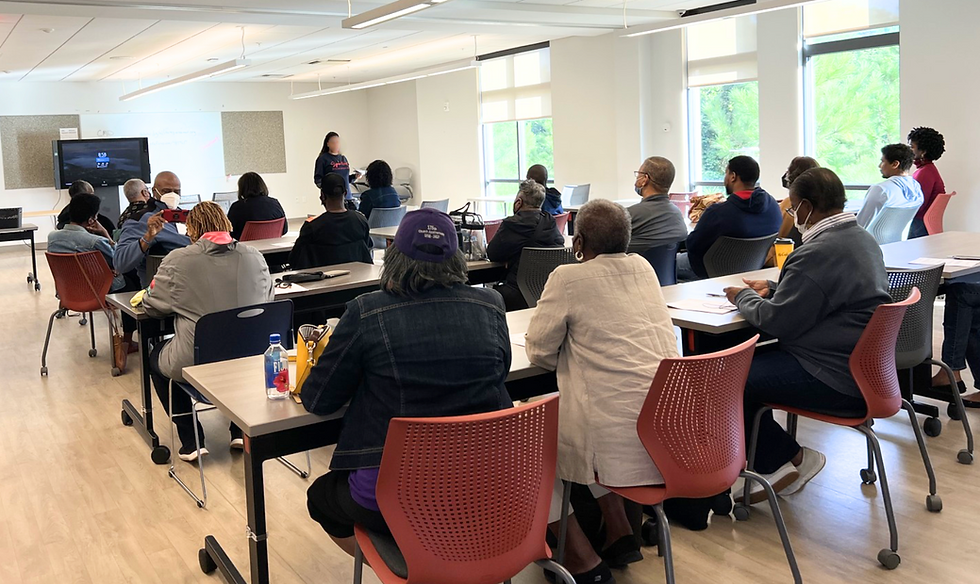
It happens in person, too. I’ve watched entire conference presentations and have sat in large meetings where half of the room is bowed over laptops and cell phones, fingers flying across keyboards while someone at the front flips through slides. I’ve done it myself – nodding at the right moments while also replying to a message or drafting a reminder for the next day. My body is in the chair, my name is on the sign‑in sheet, but a good portion of my attention is elsewhere. From the outside, it looks like participation. On the inside, it’s more like experience‑adjacent.
Of course, some of this experience‑adjacent behavior is a reasonable response to rooms that haven’t earned our full presence. Not every webinar deserves an hour of attention. Some meetings are scheduled out of habit, with no clear purpose beyond “we’ve always met on Tuesdays.” In those cases, our drift toward email and side tasks isn’t just a failure of discipline; it’s feedback about the design and intent of the space itself. If people are consistently half‑there, that might be data about the gathering, not proof that participants simply need to try harder to perform engagement.
If I’m honest, there’s a noticeable difference between the version of me that’s just occupying a seat and the version that’s actually there. When I’m half‑there, my body angles toward a device. My eyes repeatedly drift up to the clock or down to the home screen on my phone. I look at the projected slides or handout and nod on occasion to appear engaged. When I’m really in it, my body rearranges itself. My torso is directed toward the person who’s talking. I stop typing. My eyes stay on the faces in the room, not the screen. I hear myself ask a follow‑up question, not because it’s my job to keep the discussion going, but because I’m genuinely curious. The gathering might look the same from the back row – same agenda, same chairs – but inside my body, one version of me is performing and the other is participating.
This is the tension I’m circling in this season of my Body of Work: the difference between being there in body and being there in mind and spirit – and how often my particular Black female body is read as “on duty” before I’ve decided whether I’m actually available. I’m trying to notice when my body is doing the showing up while my self lags behind, and to get more honest about what I’m truly offering in those moments: headcount, symbol, or presence.
If you facilitate learning or lead others, you might sit with a few questions of your own:
In which rooms does your body routinely show up while your mind and spirit are somewhere else – staff meetings, family gatherings, community events?
Where do you want to keep it that way, on purpose, and where do you sense an invitation to arrive more fully?
This week, in a room you’re already planning to enter, how might one concrete move— a closed laptop, a moved chair, an honest question — help your self come closer to where your body already is?”
And this week, in one room you’re already planning to enter, what small shift – a closed laptop, a moved chair, one honest question – might help your self arrive a little closer to where your body already is?


Comments